
Things to Do in Chinatown, NYC
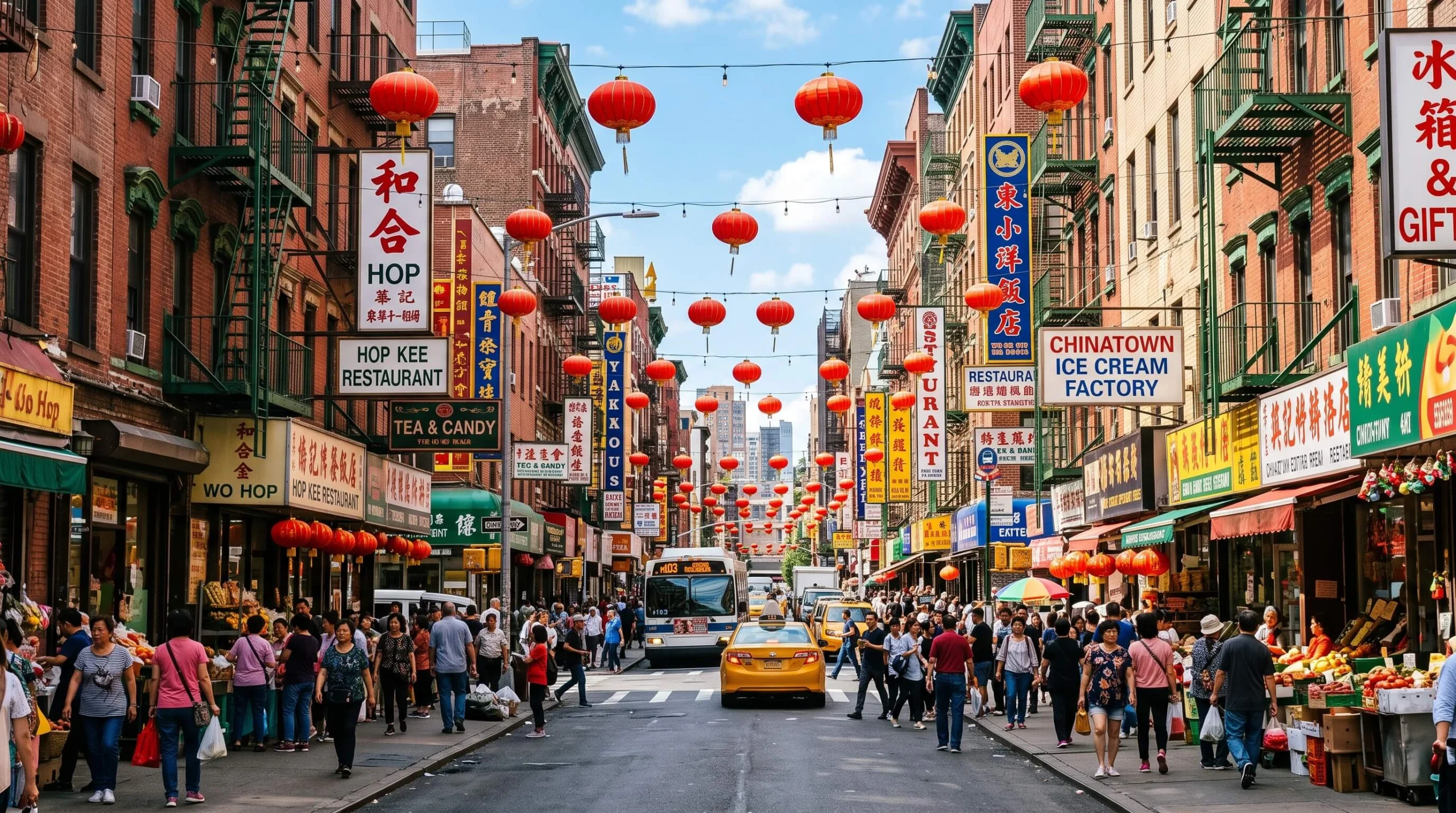
Doyers Street bends at a sharp angle. Locals still call it the Bloody Angle, a name earned from gang ambushes that happened there a century ago. That one block sets the tone for the rest of Chinatown, a neighborhood where history sits right next to the dim sum cart.
Manhattan’s Chinatown covers roughly 40 blocks south of Canal Street, one of the largest Chinese enclaves outside Asia. Temples, tea parlors and family-run shops fill storefronts that have not changed hands in decades.
Walk this route and you cover the things to do in Chinatown NYC from the bend on Doyers Street to the markets along Canal Street. Nom Wah Tea Parlor, the city’s oldest dim sum house, has been serving since 1920.
Where to Start in Chinatown NYC
| Spot | Known For |
|---|---|
| Doyers Street | The Bloody Angle’s gang history |
| Nom Wah Tea Parlor | NYC’s oldest dim sum, since 1920 |
| Mahayana Buddhist Temple | A 16-foot gold Buddha |
| Columbus Park | Tai chi and mahjong on old Five Points ground |
| Canal Street | Markets, subway access and the bridge arch |
Walk the Bend on Doyers Street

Doyers Street runs one short block between the Bowery and Pell Street, with a sharp bend at its middle. Hendrik Doyer, an 18th-century Dutch immigrant, ran a distillery and tavern where the street meets the Bowery. The block took his name.
In the early 1900s, rival tongs used the blind curve to ambush each other, which earned the street its nickname, the Bloody Angle. A 1905 attack during a theater performance became one of the most infamous incidents in the neighborhood’s history.
Fun Fact
A tunnel once connected Doyers Street to Chatham Square, giving fighters and their targets a way to disappear after a fight.
Eat Where Chinatown Has Eaten Since 1920

The Nom Wah Tea Parlor opened on Doyers Street in 1920 and still holds the title of the neighborhood’s oldest restaurant. It moved a few doors down to 13 Doyers Street in 1968 and has stayed there since.
The menu started as tea and pastries, built around an almond cookie recipe that is still on offer. Dim sum came later and turned Nom Wah into the stop most visitors put first on their list. For soup dumplings, guides often point to Joe’s Shanghai.
Find the Sixteen-Foot Buddha

The Mahayana Buddhist Temple sits at 133 Canal Street, at the foot of the Manhattan Bridge. It holds the largest Buddha statue in New York City.
The gold statue rises 16 feet on a lotus base, flanked by a pair of guardian lions at the entrance. Visitors are welcome most days before early evening. Modest dress covering shoulders and knees is expected inside.
Visiting in winter? Our guide to Christmas destinations in the USA puts New York in context.
Sit Where Five Points Used to Be

Columbus Park sits on ground that was once the center of Five Points, a 19th-century neighborhood city reformers eventually tore down. The park opened in 1897 under the name Mulberry Bend Park, designed by Calvert Vaux, the co-designer of Central Park. Crossing the river to Brooklyn gives a very different mood, as our guide to Williamsburg, Brooklyn shows.
These days the park runs on a quieter rhythm. Mornings bring tai chi. Afternoons bring mahjong tiles clicking on folding tables. Both have been part of the routine for generations.
Good to Know
Columbus Park is free and open year round, with no set hours for watching the tai chi and mahjong games. See the NYC Parks history page for the full Five Points story.
Shop and Snack Along Canal Street

Canal Street cuts straight through Chinatown and doubles as its main transit hub. The 6, N, Q, R, W, J and Z trains all stop nearby, along with the A, C and E lines a few blocks over.
Stalls along the street sell everything from fish-shaped waffle cones to jewelry and phone cases. The Manhattan Bridge Arch and Colonnade rises where Canal Street meets the Bowery, a Beaux-Arts gateway built between 1910 and 1915 and modeled partly on a Paris landmark.
Wander Mott Street’s Storefronts
Chinatown is changing, so expect some disruption. News from August 2026 says site work has started for a new jail on Centre Street, a casino proposal is dividing residents, and a traffic redesign near Kimlau Square is being debated again. Stay alert on the Bowery near Hester Street, where a truck jumped the curb last month, and keep to the crosswalks.

Mott Street runs through the oldest part of Chinatown, lined with restaurants, bakeries and shops stacked close together. Every block holds a different specialty, from barbecue windows to herbal medicine counters.
The Museum of Chinese in America sits nearby on Centre Street, in a building designed by architect Maya Lin. It holds more than 85,000 artifacts covering the history of Chinese immigrants in America.
Listing prices help you plan the museums. The Museum of Chinese in America is about $15 and the Museum at Eldridge Street about $15.90.
The Museum at Eldridge Street is another favorite stop nearby, and reviewers suggest giving it at least an hour. Lunar New Year brings a parade and festival through the neighborhood each winter, with 2026 marking the Year of the Fire Horse.
Step Into Little Italy Without Leaving

Mulberry Street north of Canal marks the start of Little Italy, a few blocks that still hold onto red-sauce restaurants and imported grocers. The two neighborhoods sit close enough to cover both in one afternoon.
The Feast of San Gennaro takes over Mulberry Street every September. What began as a single day of celebration in 1926 has grown into an eleven-day run of food stalls, music and a religious procession.
Frequently Asked Questions
Chinatown Rewards a Slow Walk
The pull of this neighborhood is not one landmark. It is the layering: a Beaux-Arts arch a few steps from a Buddhist temple, a park built over a slum, a tea parlor older than most of the buildings around it.
Plenty more routes and ideas wait in North America and Things to Do.


